


Presentation
What is a Master Cycle in Corporate Finance and Risk?
INSEEC Grande École programme, specialising in Corporate Finance and Risk, prepares you for careers in corporate finance, financial engineering and risk management. This course confers a Master’s degree and is RNCP level 7 (equivalent to 2nd year postgraduate) recognised by the Ministry of Higher Education and Research. The course is taught in French, giving you optimum employability in the French and European job markets.
Diploma and professional certification
This state-approved degree confers Master’s status and has been AMBA accredited since 2016, guaranteeing its recognition in France and internationally. Professional certification as an Innovative Projects Manager level 7 (EU), NSF code 310, awarded by INSEEC Grande École, registered under number 41044 on the RNCP (Répertoire National des Certifications Professionnelles) by decision of the Director General of France Compétences.
Objectives and skills
The aim of the INSEEC Grande École Corporate Finance and Risk programme (leading to a Master Cycle) is to train finance specialists capable of managing equity transactions and assessing the financial risks of organisations.
The programme develops key skills in :
- Financial engineering and venture capital
- Business valuation and mergers & acquisitions
- Corporate finance and financial strategy
- Asset management
- International capital markets
- Risk management and compliance
- Financial modelling (VBA & Python)
- In-depth financial analysis
The content
The courses below are offered on the Paris, Lyon and Bordeaux campuses. The programme, taught in French, is regularly updated to take account of changes in financial practices and regulations.
1ʳᵉ year (Level L3)
60 ECTS credits
This first year of the sandwich course lays the foundations of management and develops your understanding of global economic and financial issues. Students benefit from a week’s immersion in London at the start of the programme.
- Understanding the world’s major issues
- Intercultural skills
- Developing critical and independent thinking
- Become an expert, responsible and efficient manager
- Supervised collaborative work: INSEEC Personal Project
- Undertaking and leading change
2ᵉ year (M1 level)
60 ECTS credits
The second year of the work-linked training programme deepens your financial and managerial skills, building up your expertise in corporate finance.
- Building autonomy and the ability to decipher the world
- Professional methods, skills and practices
- Career paths
3ᵉ year (Level M2) – Core curriculum
60 ECTS credits
The core curriculum strengthens your strategic, ethical and management skills in complex financial contexts. This final year of the PGE is a sandwich course.
- Open Innovation Challenge
- Research Methodology Seminar
- Advanced Management
- Business Ethics & Corporate Social Responsibility
- Crisis Management Night
- Preparing for the Grand Oral
3ᵉ year (M2 level) – Specialisation courses
Speciality courses develop your technical expertise in corporate finance, financial engineering and risk management.
- Financial engineering and venture capital
- Business valuation and mergers & acquisitions
- Company financing
- Applied Finance
- Asset management
- International Capital Markets
- Finance case studies
- Advanced Corporate Finance
- Risks and Compliances
- VBA & Python.
Assessment procedures
The assessment combines several methods to validate your theoretical and practical financial skills:
- Continuous assessment and regular evaluations.
- Individual projects and group work.
- Half-yearly and final examinations.
- Analysis of financial cases and sector studies.
- Financial modelling and simulations.
- Oral presentations and defence.
- Applied research dissertation in finance.
- Compulsory in-company periods and professional assessment.
Certification is obtained by capitalising on all the skill blocks and validating the 180 ECTS credits over the 3 years of the programme.
Is this degree recognised by the State?
INSEEC Grande École awards a Master in Management, officially recognised by the French State (Ministry of Higher Education and Research) since 2005. The degree is recognised in France and internationally and has been AMBA-accredited since 2016. The programme also awards a Level 7 RNCP qualification, recognised by the French Ministry of Labour. INSEEC Grande École is a member of the Conférence des Grandes Écoles.



Campus
Accros France
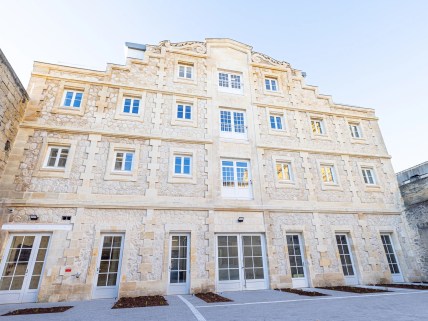
Business school in Bordeaux
Join a modern, friendly campus on the banks of the Garonne, in the heart of a lively, friendly city.

Business school in Lyon
Take advantage of a historic campus in the heart of Lyon, one of France’s most dynamic cultural and student cities.

Business school in Paris
Discover three modern, easily accessible campuses in iconic Paris locations.
1/3
Testimonials
Our students are satisfied
-
As part of a work-study program at Elba France, I progressed from assistant to junior project manager and now oversee the rollout of campaigns resulting from calls for tenders. INSEEC Grande École provided me with the framework I needed to progress, and if I have one piece of advice, it is to have confidence in your abilities.
Gloria-Divine Ombongo-Pea
-
After an exchange program in London, I completed an internship in real estate and digital marketing in Malta. This international immersion experience strengthened my skills and broadened my horizons.
Giscard Rasolondraibe
-
After earning a bachelor’s degree in Applied Foreign Languages, I chose INSEEC for a Grande École program in marketing, taught entirely in English and offered as a work-study program. At Fives Machining, I carry out a variety of tasks, from market research to digital strategy, which are perfectly in line with my international ambitions.
Emma Huard
Key figures for class 2025
For RNCP title n°41044
“DipViGrM – Grande Ecole Programme
Employment rate 6 months after graduation
Certification completion rate
Global rate of Graduation
Satisfaction rate
Rate of students continuing their education: 2.2%
Dropout rate: 1.18%
Professional experience
A career path
This work-study programme enables you to put your skills in corporate finance, financial engineering and risk management into practice. You will join finance departments, consultancies or financial institutions and build up recognised expertise in corporate finance.

INSEEC Grande École supports you
Personalized support in your search for a work-study program in corporate finance, with dedicated guidance throughout your journey.

Job dating
Monthly sessions with our partner companies: finance departments, investment banks, financial consulting firms.

Match’Up
Thousands of work-study opportunities and internships in corporate finance, M&A, risk management, and asset management available online.

Corporate and Alumni Relations Department
A network of 10,000 partner companies and 115,000 alumni to accelerate your career in corporate finance.

Coaching Workshop
Group or individual sessions every week: finance CVs, technical interviews, case studies, etc.
Business
What are the career opportunities after a Master Cycle in Corporate Finance and Risk?
The Master Cycle in Corporate Finance and Risk positions you in strategic corporate finance functions. These high value-added professions offer rapid career paths to finance management and equity advisory positions.

Application
What are the admission requirements for the Master Cycle in Corporate Finance and Risk?
Admission to 1st year (Level L3)
- Accessible to students holding or in the process of obtaining a BUT, BTS, Licence 2, RNCP level 5 certified qualification (Bac +2), or enrolled in 2ᵉ year of IEP.
- Admission via the Evolution 1 competitive entrance examination (application + oral tests).
- Training given in French.
Admission to 2nd year (M1 level)
- Open to students who have completed or are in the process of completing a Licence 3, Bachelor’s degree, Master 1, engineering degree or level 6/7 RNCP-certified qualification attesting to at least 3 years of higher education.
- Admission via the Evolution 2 competitive entrance examination (application + oral tests).
- Training given in French.
Are you in a preparatory class?
- You can enter the first year of the Grande École programme by taking the BCE competitive entrance examination.
Your application
- Submitting your application
- Admission test
- Eligibility results
Tuition fees
What are the tuition fees for the Master Cycle in Corporate Finance and Risk?
Tuition fees vary from year to year. Several financing solutions are available to support you.
- 2nd year undergarduate
- 1st year 1-year€12 950
- 2nd year 1-year€13 390
- 3rd year 1-year€13 390
- Grade de Master Degree
Financial aid
INSEEC offers a number of financial aid schemes:
Alternating work placements or work-study contracts
Banking partnerships and their advantages
- 2nd year undergraduate
- 1st year 1-year€12 950
- 2nd year 1-year€13 390
- 3rd year 1-year€ 13 390
- Grade de Master Degree
Visit us at
Discover the INSEEC Grande École events
Event type
-
Grande École
25/03
Open House Days Online
-
Grande École
08/04
Open House Days Online
FAQ
All you need to know about the Master Cycle in Corporate Finance and Risk
Answers to your questions about the Master Cycle in Corporate Finance and Risk. Our teams are at your disposal!
Let’s meet
Still not sure? Meet our teams to help you make the right choice!
What are the objectives of the Master Cycle in Corporate Finance and Risk?
This course aims to train financial experts capable of structuring complex financing operations, valuing companies, managing mergers and acquisitions and managing financial risks. You will develop cutting-edge technical knowledge in financial engineering and corporate finance to support companies in their strategic financing and development decisions.
Is the INSEEC Grande Ecole Master Cycle in Corporate Finance and Risk recognised by the State?
Yes, the Master’s Degree in Corporate Finance and Risk provides a Bac +5 diploma conferring the Grade de Master, recognised by the State since 2005. It has been AMBA accredited since 2016 and is RNCP level 7 certified (record 41044). INSEEC Grande École is a member of the Conférence des Grandes Écoles.
Which partner companies recruit students from this programme?
INSEEC’s network of 10,000 partner companies regularly recruits graduates of the Corporate Finance and Risk PGE (Grande École Programme):
- Finance departments of large groups and SMEs.
- Investment banking and corporate finance (Société Générale, BNP Paribas).
- Financial strategy consultancy firms.
- Private equity and venture capital funds.
- Asset management and insurance companies.
Is it possible to do work-study during the INSEEC Grande Ecole Master Cycle in Corporate Finance and Risk?
Yes, it is possible to follow a sandwich course over the 3 years of the programme. This format allows you to acquire solid expertise in corporate finance while financing your training through an apprenticeship or professional training contract, thus facilitating your access to employment.
What soft skills are developed following a Master’s degree in Corporate Finance and Risk?
This programme develops the essential qualities needed to excel in corporate finance:
- Analytical rigour and precision in calculations.
- Ability to synthesise complex financial information
- Financial communications for non-specialists.
- Resistance to stress and meeting deadlines.
- Professional ethics and confidentiality.
- Team spirit and cross-functional collaboration.
Which languages are used for courses and exams?
Teaching for the Master’s degree in Corporate Finance and Risk is conducted in French. However, a command of financial English is strongly recommended in order to understand international technical documentation (IFRS standards, financial publications) and to work in international groups. The curriculum includes technical vocabulary in English to prepare students for international professional contexts.
What is the difference between “Corporate Finance and Risk” and “Finance, Audit and Control”?
The Corporate Finance and Risk Masters focuses on financial engineering, mergers and acquisitions, financing and strategic financial risk management.
The Master’s degree in Finance, Audit and Control is geared more towards auditing, management control and financial accounting. The first prepares students for careers in financial management and corporate finance consulting, while the second prepares students for careers in auditing, control and accounting compliance.
What profiles are needed to become a financial analyst?
To become a financial analyst, recruiters are looking for profiles that combine analytical rigour, mastery of modelling tools (Excel, VBA, Python) and the ability to communicate financial recommendations. INSEEC’s Corporate Finance and Risk programme develops these skills through case studies, sector analyses and company valuation projects.
How do I apply for the Master Cycle in Corporate Finance and Risk?
You apply via the Evolution 1 (after a 2nd year undergraduate) or Evolution 2 (after a 3rd year undergraduate level and 1st year postgraduate) competitive entrance exams. The process includes an application file and oral tests to assess your motivation for finance, your knowledge of economic issues and your career plan. Applications are made online on the INSEEC website.
If you are in a preparatory class, you can enter the 1st year of the Grande Ecole Master Cycle via the BCE competitive entrance exam.
Made for you
Our other INSEEC Grande Ecole Master Cycle
Specializations
Campus
-
- 1st year postgraduate
- 3rd year undergraduate
CGE accredited MSc – Sustainable Tourism Management
-
- 1st year postgraduate
- 3rd year undergraduate
CGE accredited MSc – International Business Management
-
- 2nd year postgraduate
Executive DBA Business Economics and Transitions
-
- 2nd year undergraduate
- 3rd year undergraduate
Master Cycle in Corporate Finance & Financial Analysis
-
- 2nd year undergraduate
- 3rd year undergraduate
Master Cycle in Digitalisation, AI and Big Data
-
- 2nd year undergraduate
- 3rd year undergraduate
Master Cycle in Entrepreneurship, Management and Leadership