
Career Guide
Tour guide
The role of a tour guide involves supervising groups on sightseeing tours, ensuring their comfort, the quality of the guided tours and that the planned itinerary is followed.
The profession
What is a tour guide?
His role
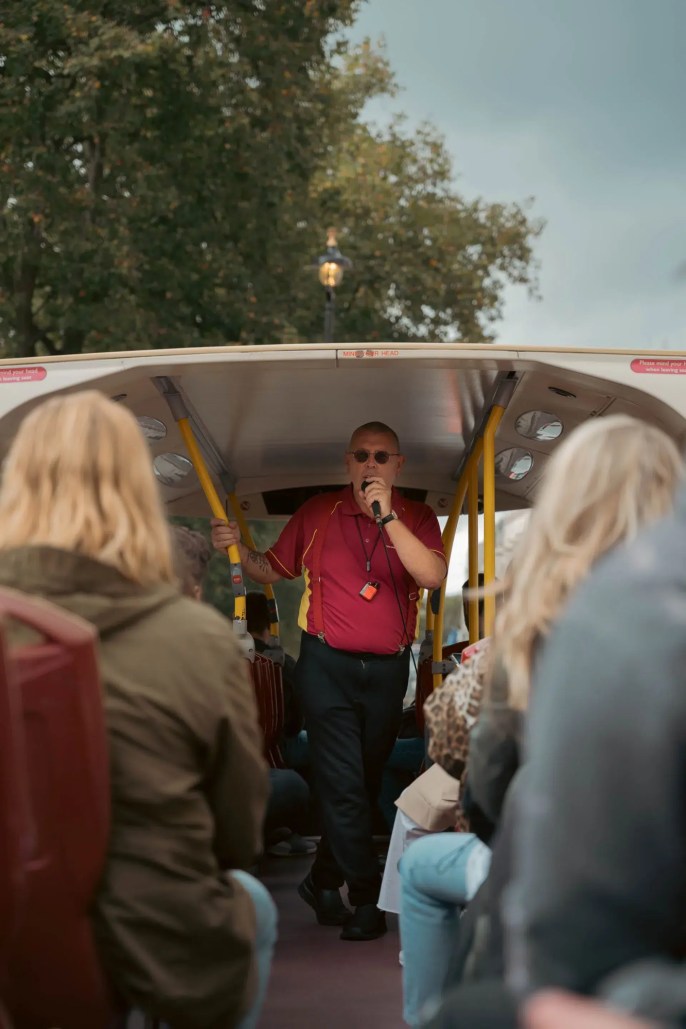
A tour guide supervises groups of travellers on excursions or sightseeing tours. You ensure that the trip runs smoothly, assist with administrative formalities and act as a liaison between participants and local service providers. Your role is to ensure the quality of every aspect of the tour, from the welcome right through to the return journey.
Its scope of activity
You mainly work for travel agencies, tourist information centres or coach companies. The majority of tour guides work on a self-employed basis, either on a per-trip or flat-rate basis, on assignments lasting a day or a week, both in France and abroad.
The functions
What are the duties of a tour guide?
The duties of a tour guide include the organisation, facilitation and day-to-day management of tourist tours, from the planning stage right through to the group’s return.
Review the tour itinerary with the tour operator before departure
Sharing knowledge about the natural and tourist heritage of the destinations visited
To offer practical advice on the best places to visit and sites worth exploring
Write trip reports for the organising agency
To assist with administrative formalities on arrival and accompany travellers to their accommodation
Dealing with unforeseen circumstances (delays, cancellations, health issues) in a responsive manner
To represent the travel agency in the field and help build customer loyalty
Coordinate guided tours and ensure that timetables are adhered to
Ensure a warm welcome for different groups of visitors and tailor the activities to the group’s expectations
Approach travel agencies to diversify the range of assignments
Qualifications
Qualities and skills required to be a good tour guide
The role of a tour guide relies on a balance between cultural and geographical knowledge, a commitment to customer service and the ability to handle unforeseen situations. Fluency in French and English is a basic requirement, and knowledge of a second foreign language is an asset recognised by recruiters in the sector.
From an organisational perspective, you must be able to manage complex tour itineraries, anticipate unforeseen circumstances and coordinate several service providers simultaneously. Knowledge of history, art history and geography enhances the quality of discussions during guided tours and meets the expectations of the most inquisitive visitors. The ability to lead a guided tour in a clear and engaging manner is also required.
Personal qualities are just as important: sociability, a willingness to help and active listening enable you to adapt to each group. Organisational skills, responsiveness and a dynamic personality are essential for ensuring participants’ satisfaction throughout their stay. Career progression and employment in this sector depend largely on the reputation built up over the course of various assignments.
The benefits
What are the benefits of working as a tour guide?
Tour guides generally have their travel and accommodation expenses covered whilst on tour, and meals are included in the daily packages. Language allowances are sometimes paid to multilingual staff.
Working as a freelancer offers a great deal of freedom in choosing assignments and destinations. Experienced tour guides can earn over €36,000 gross per year during the high season with a loyal client base, according to cross-referenced data from ONISEP and the sector’s collective agreement.
Remuneration
Tour guide: salary and career progression
At the start of their career, a salaried tour guide’s remuneration ranges from €19,200 to €22,400 gross per year, which is close to the minimum set by the Collective Agreement for Travel Operators (CCN No. 3061). After five to ten years’ experience, the salary rises to between €26,000 and €30,500 gross per annum. Specialist roles, particularly multilingual tour guides working for cultural institutions or high-end tour operators, can earn between €30,000 and €36,000 gross per year. The vast majority of tour guides work on a per-trip or flat-rate basis, with a daily rate of between €80 and €90 gross per day (source: ONISEP), which may exceed €100 for experienced professionals. Guides based in the Île-de-France region earn on average 10 to 20 per cent more than those in other parts of the country. Regions with high tourist appeal, such as Provence-Alpes-Côte d’Azur (PACA) or Auvergne-Rhône-Alpes, offer slightly better conditions than other areas. With experience, a tour guide can progress to roles such as tourism product manager, travel agency manager or tourism trainer. Setting up a specialist agency (themed tours, ecotourism) is also a possible career path.
Up to
€36,000
Annual salary
Training courses
What qualifications do you need to become a tour guide?
Our training courses
Entry into the profession of tour guide is possible with a two-year post-A-level qualification, notably through a BTS in Tourism or a vocational bachelor’s degree in tourism and leisure. A bachelor’s or master’s degree in tourism management opens the door to positions of greater responsibility.
With experience, it is possible to train as a tour guide to obtain a professional licence, or to specialise in a particular type of tourism.
Discover
Other careers you might be interested in
This course also opens the way to careers as a tour guide and a tourism product manager.






Everything you need to know about
Our guides
Take a look at our guides to find out everything you need to know about education, work-study schemes and careers.