
Trade guide
Trader
The business
What is a Trader?
Its role
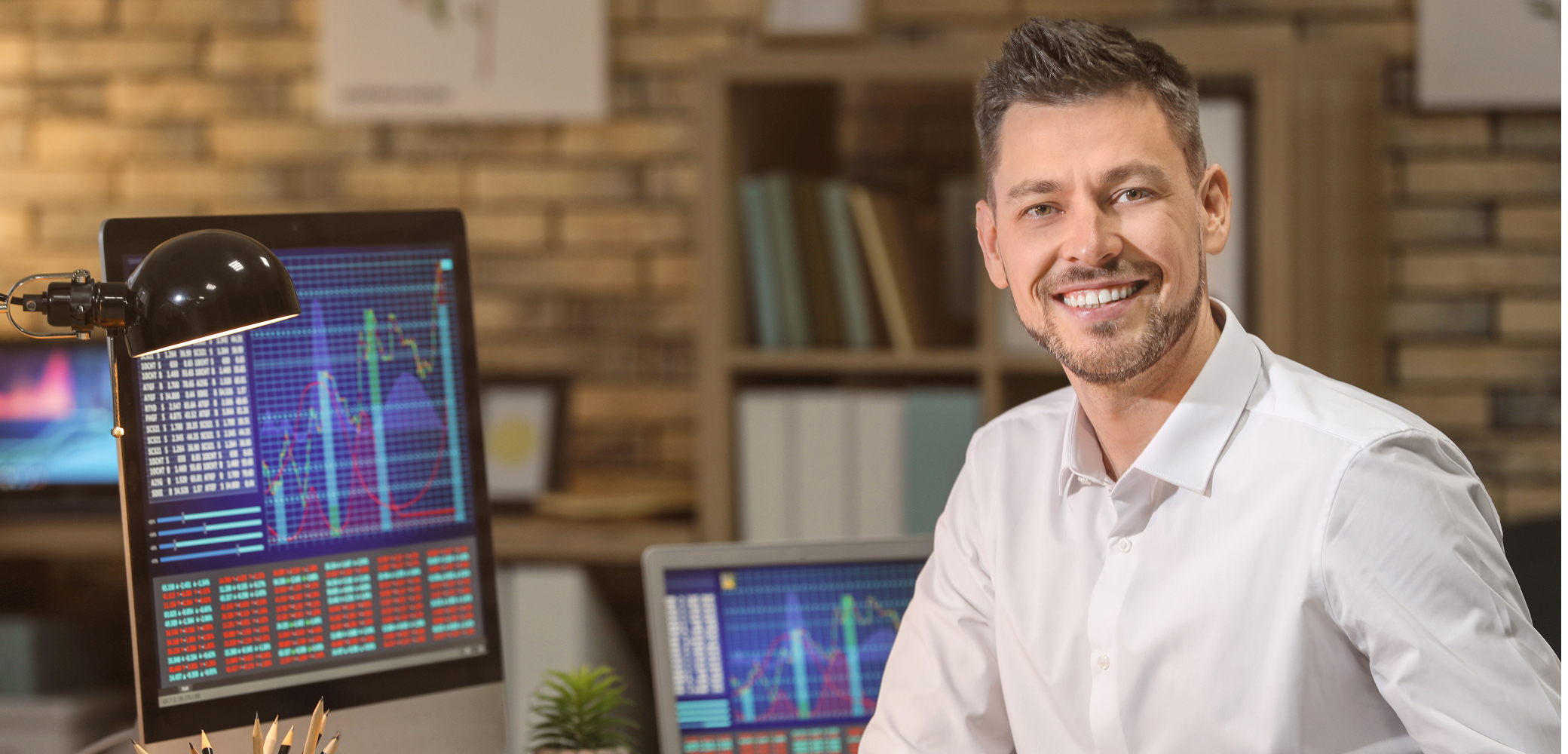
The job of a trader involves dealing with financial risks, in particular buying and selling shares, bonds or currencies. The trader’s activity is particularly intense and hectic, requiring constant responsiveness so as not to miss out on any market fluctuations. At the heart of international trade, the trader anticipates risks and masters all aspects of the economy, in particular through advanced mathematical, statistical and computer skills.
Its field of action
At the heart of the trading floor, the trader works on behalf of a bank or company seeking to make a profit, based on developments on the international markets. They measure, fix and negotiate transactions, often within a very limited timeframe. Each of these actions is validated by security gateways: the Middle Office and the Back Office. Traders are usually based in major cities (where stock exchanges are located), but they can also work for themselves as day traders (selling and buying shares in a single day).
Studies
What are the requirements to become a trader?
Being a trader is a highly responsible job, requiring a significant amount of study to reach maturity and be effective in the role. To acquire the skills needed for the job, a trader needs to complete at least 5 years of post-baccalaureate study, in addition to other training, in particular a course in financial risk management. There is no single route to success. There are several examples to illustrate the type of training required:
- Engineering degree with additional training in finance
- Specialised and professional Master of Science in fields such as management, finance, mathematics, banking, law and statistics
- Grande école programme diploma
- Master MBFA – Money, banking, finance, insurance
- IEP Diploma in Finance
- MS expert in banking and financial engineering
All in all, the job requires solid theoretical training as well as significant experience in banking or the stock market. Finally, appropriate vocational training is essential to validate what you have learnt and to finally be able to work in a front office.
Developments
What are the career prospects for a trader?
A trader’s job is particularly intense and stressful, and can change over the course of his or her career. On average, a trader’s job is held for 15 years before migrating to another activity, often advisory services. This is something that needs to be taken into account and considered as soon as you take up the job.
In practical terms, given his qualifications and experience, he can work in all areas of finance and the stock market. His in-depth knowledge of the market means he can apply for any type of job in this sector. Provided, of course, that he does not wish to change his career path completely.
There are two options available:
Specialising in asset management
- raw materials
- currency
- Treasury bills
- energies
- actions
Moving into finance or stock market-related professions
- financial analyst
- fund manager
- market maker
- portfolio manager
- company treasurer
- order execution controller
Other finance courses are also available at INSEEC.
Remuneration
How much does a trader earn?
A trader’s salary is highly variable and depends on a number of factors. In particular, their level of seniority, their place of business, their location, etc.
Their remuneration is made up of a fixed base plus bonuses based on profits made. These can be up to 8 times the initial salary.
In practical terms, a junior trader starts on a salary of between 4,000 and 6,000 euros net per month. The average salary for the profession is around €70,000 net per year, excluding bonuses which can run into tens of thousands of euros.
Up to
70 000€
Salary per year
Training courses
What training should I do at INSEEC to become a trader?
Our training courses
To meet the growing demand for experts in trading and asset management, INSEEC has created the Master of Science in Financial Markets and Trading. Aimed at graduates with 3, 4 or 5 years of higher education, the programme prepares students to master a wide range of complementary disciplines:
- Market finance
- Financial analysis
- VBA and statistical tools
- Portfolio management of financial assets
- Mandatory contracts
- Financial engineering and venture capital
In order to enrich its traditional base, the school offers new disciplines that are deeply rooted in modern finance. At the heart of the course, you will find resolutely innovative elements:
- Big data
- Fintech
- Smart contracts
- Stochastic simulations
- Behavioural finance
Students put new methodologies into practice and are regularly put into real-life situations via an authentic trading room, right on the school premises. This puts students at the heart of real-life cases, so that they are as well prepared as possible for the realities of the market. With 15 years’ experience and development under its belt, the programme is a benchmark in the field and boasts a network of over 500 alumni with a proven track record in the sector. With certification from the Autorité des Marchés Financiers during the course of the programme, it is the most comprehensive course for a successful career in trading.

FAQ
Feel free to consult the other questions asked about Finance
- How can I get a grant to study in Finance?
- What are the main areas of finance?
- What is the difference between a Bachelor’s degree and a Licence in Finance?
Discover
Other jobs that may interest you
INSEEC offers a wide range of programmes to help you train for your dream job.








All about
Our guides
Consult our guides to find out all you need to know about education, work-linked training and careers.